Written and clinically reviewed by Shang Jul Rasul Olsen, Clinical Psychologist and specialist in MCT, rumination and worry.
Last clinically reviewed: July 2026
In this article, I will help you distinguish between natural human feelings and patterns that have become persistent, feel uncontrollable and may require therapy.
Do I need therapy? The short answer
You may benefit from therapy when distress is persistent, when worrying, ruminating, checking or monitoring feels uncontrollable, and when the pattern takes up a great deal of time or substantially restricts work, sleep, relationships, self care or ordinary activities. A painful feeling that fits the situation and does not seriously restrict your life is not automatically a disorder. Negative feelings can also appear without a clear connection to a particular event and still not require treatment. If you are unsure, ask a qualified mental health professional for an individual assessment.
This article can help you recognise the important differences, although it cannot diagnose you.
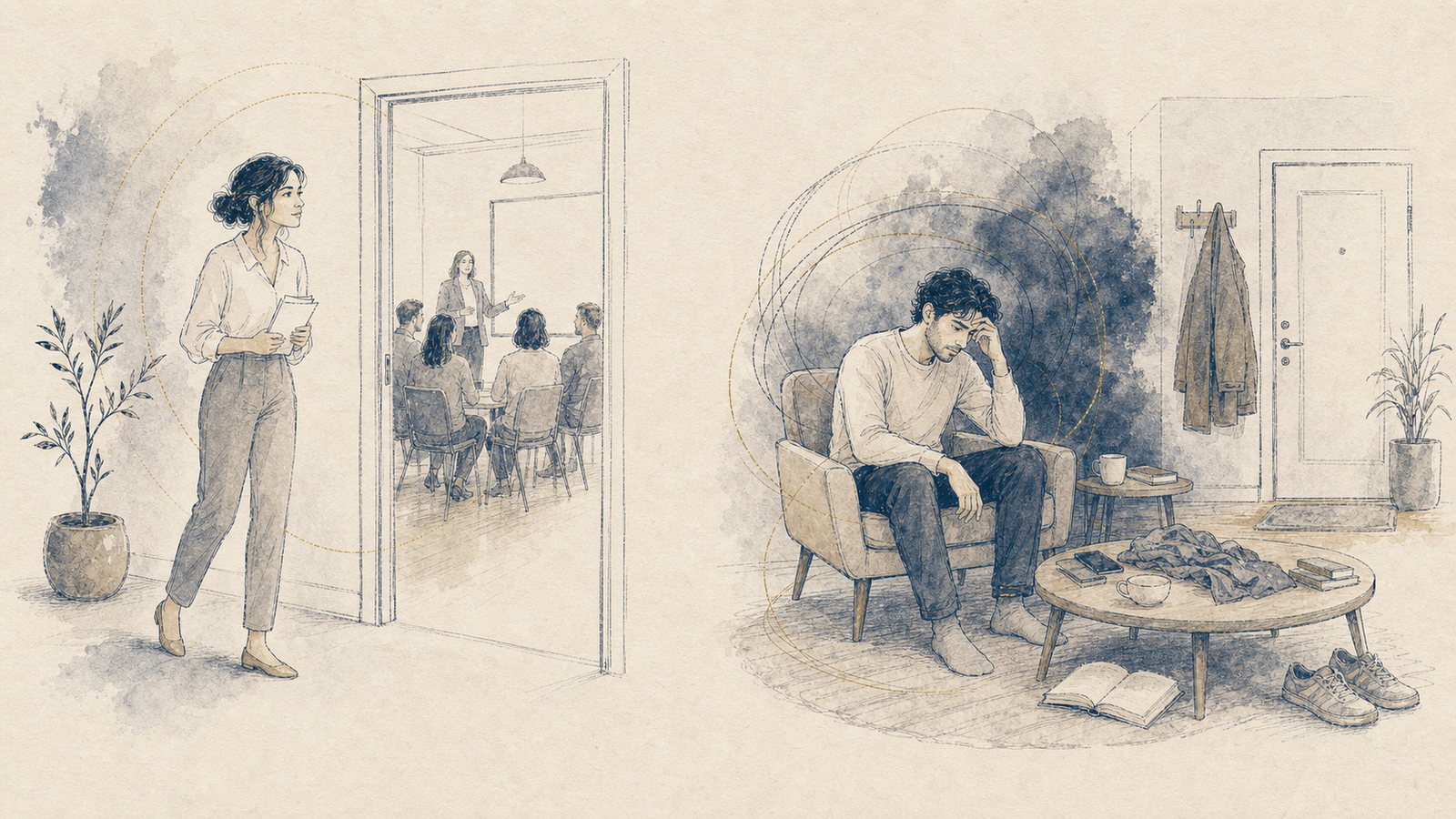
Consider Anna and Jonas.
Anna and Jonas are both about to present something at a work meeting.
They both feel nervous.
Anna notices that her heart is beating faster. She feels tension in her stomach and has the thought:
“What if I forget what I want to say?”
She does not enjoy the feeling, but she leaves it alone.
Anna joins the meeting and gives the presentation while she is still nervous. As she begins speaking, she returns her attention to what she wants to explain. Afterwards, she continues with the rest of her day.
Jonas notices the same kind of nervousness before his presentation.
But Jonas begins checking how anxious he feels. He opens his phone and searches online for ways to stop the anxiety. He monitors his heart, goes through everything that could go wrong and worries about whether the other people in the meeting will notice that he is nervous.
The next time he has to present, he does the same thing.
Over time, this becomes a repeated pattern. Before every presentation, Jonas checks, searches, monitors and worries. He spends more and more time trying to make sure that he will not feel anxious or make a mistake.
Eventually, Jonas feels unable to stop worrying. He starts avoiding presentations when he can and feels trapped in a persistent presentation anxiety problem.
Anna and Jonas began with the same situation and the same ordinary feeling of nervousness.
The difference is what they did next and what they continued doing over time.
Anna allowed the nervousness to be present and continued with the meeting. Jonas repeatedly tried to control the nervousness through checking, online searching, monitoring and worrying. The pattern gradually took more of his time and began to restrict what he could do.
This is why the presence of anxiety alone cannot tell us whether somebody needs therapy. We also need to look at how the person responds, whether the pattern keeps repeating and how much it affects daily life.
Now consider a different feeling.
Maya and Daniel both reach Friday evening without any plans. They open social media and see photographs of friends having dinner with their partners.
They both feel lonely.
Maya does not like the feeling, but she does something about the concrete situation in front of her. She calls a friend and asks whether she wants to go for a walk.
Her friend already has plans.
Maya still feels disappointed and lonely. She decides to go to the gym, speaks briefly with a neighbour when she comes home and spends the rest of the evening reading.
She has not made the loneliness disappear. She has taken a relevant action where action was possible, and she does not spend the rest of the evening analysing what the feeling means about her future.
Daniel also feels lonely when he sees the photographs.
But Daniel begins asking himself:
“What if I am alone for the rest of my life?”
He opens his ex partner’s profile and looks through recent photographs. Then he searches for people he went to school with to see who is married, who has children and who appears to be happy.
He compares their lives with his own and continues analysing why he has not found the right person. He goes through previous relationships, looks for evidence that he did something wrong and tries to work out whether he will ever meet somebody.
Several hours later, Daniel has not changed the fact that he has no plans that evening. He feels more lonely, more insecure and further away from contacting somebody.
Maya and Daniel began with the same situation and the same feeling.
Maya responded to the concrete problem. She reached out to somebody. When that person was unavailable, she allowed the disappointment and loneliness to remain while she continued with her evening.
Daniel tried to use analysis, comparison and online checking to answer a question about his entire future. If he responds this way each time loneliness appears, the feeling can become the beginning of a repeated pattern of rumination and monitoring.
Again, the distinction is not whether the feeling is real.
The distinction is what the person continues doing with it, whether the response helps with the actual situation and what the pattern begins to cost.
This is not an argument against therapy
I am a psychologist.
I believe in therapy, and I have been in therapy myself.
This article is not about proving that people should manage alone. It is not about deciding that some people are strong and other people are weak. It is not about judging anybody for seeking help.
It is about matching the response to the problem.
Some people urgently need treatment and cannot access it.
Some people need a professional assessment because anxiety, depression, compulsions or prolonged overthinking have seriously affected their lives.
Some people need practical help, rest, social support or protection from circumstances that are harming them.
And some people are treating ordinary nervousness, boredom, loneliness or sadness as evidence that something is wrong with them.
The same person can experience more than one of these things.
You can have an anxiety disorder and still become frightened by ordinary nervousness.
You can need therapy and also benefit from learning that not every feeling needs attention.
There is only the question:
What kind of help fits what you are experiencing?
Where are you on the spectrum?
The following guide is not a diagnostic test. One sign by itself cannot tell you whether you have a disorder.
Use the whole pattern.
One of the most important questions is whether you can stop worrying or ruminating when you decide to, or whether the thinking feels uncontrollable.
| Look at | More consistent with ordinary, painful emotion | A professional assessment may be useful |
|---|---|---|
| The situation | The feeling often has an understandable connection to something that has happened, although not always. You may feel nervous before a presentation, sad after a rejection, lonely when you have no plans, angry after a conflict or uncertain before a major decision. | The distress may appear across many situations, continue long after an event or seem much larger than the present situation can explain. The situation alone does not decide whether you need help. Your response, sense of control and the effect on your life also matter. |
| Time | The feeling changes during the day and leaves room for other experiences. | You spend hours worrying, ruminating, checking, monitoring or trying to control the feeling, and you feel unable to stop. |
| Daily life | You can still work, study, sleep, care for yourself and maintain relationships, even if the day is difficult. | Work, sleep, eating, self care or relationships are substantially affected. |
| Avoidance | You continue with important activities while feeling uncomfortable. | You repeatedly cancel, escape or organise your life around avoiding thoughts, feelings, places or situations. |
| Flexibility | You can return your attention to the activity or person in front of you. | Your attention remains fixed on possible danger, symptoms or internal experiences for long periods. |
| Control over worrying and rumination | You may worry or ruminate briefly, but you can stop and return your attention to what you were doing. | Worrying or rumination feels uncontrollable. You try to stop but feel unable to do so. You continue thinking despite wanting to stop, and the strategies you use produce more questions, anxiety or low mood. |
| Safety | You feel uncomfortable but are not in danger from yourself or somebody else. | There are thoughts, plans or actions involving harm, or you are unable to keep yourself or somebody else safe. This requires immediate professional or emergency support. |
The difference is not whether you feel bad.
The difference is what the feeling is connected to, how long the pattern continues, what you start doing with it and how much of your life the problem takes away.
Ordinary feelings that can be very uncomfortable
Normal does not mean pleasant.
It does not mean mild.
It does not mean that you should enjoy the experience or go through it alone.
It means that the feeling can be part of an understandable human response without automatically being evidence of illness.
Here are situations that often produce real discomfort:
| Situation | A common response |
|---|---|
| Giving a presentation, going to an interview or meeting somebody new | Nervousness, physical tension, self consciousness or doubt |
| Waiting for an important answer | Restlessness, impatience and uncertainty |
| Spending an evening alone when you want company | Loneliness or sadness |
| Having no stimulation or clear task | Boredom, agitation or the urge to check your phone |
| Making a decision without complete information | Doubt and fear of making the wrong choice |
| Being criticised or making a visible mistake | Embarrassment, shame or defensiveness |
| Being rejected by a partner, friend, employer or client | Sadness, disappointment and insecurity |
| Hurting somebody or acting against your own values | Guilt and regret |
| Being treated unfairly or having a boundary crossed | Anger and tension |
| Losing a person, role, relationship or future you expected | Grief, disbelief, hopelessness and lack of energy |
| Being tired and stressed, with too much to do and too little time for the activities you enjoy | Irritation, frustration and reduced patience |
| Beginning something important that you cannot fully control | Excitement mixed with anxiety |
These feelings may still tell you something useful about the situation.
Anger may accompany unfair treatment. Guilt may be followed by an apology. Loneliness may make you decide to contact somebody. A practical problem may require action.
If you are tired, stressed and trying to manage too many obligations, irritation can be an understandable response. It does not automatically mean that something is wrong with you. It may tell you that you need to change something practical about your schedule or make more room for activities you enjoy.
But the feeling itself does not always require investigation.
You do not have to ask why you feel every moment of boredom.
You do not have to monitor whether your nervousness has disappeared.
You do not have to decide what a lonely evening says about your identity.
You do not have to analyse every change in motivation.
What does it mean to let an ordinary feeling be there?
Letting a feeling be there does not mean liking it.
It does not mean agreeing with an unfair situation.
It does not mean suppressing the feeling or pretending to be happy.
It means that you allow the feeling to be present without repeatedly:
- asking what it means
- checking whether it has gone
- monitoring your body for more symptoms
- searching the internet for an explanation
- asking other people to tell you that you are okay
- cancelling ordinary activities until you feel different
- trying to force the feeling away
You can feel nervous and give the presentation.
You can feel lonely and still cook dinner, read or call a friend because you want connection, not because the feeling must be removed immediately.
You can feel bored without filling every second with stimulation.
You can feel uncertain and allow a reasonable decision to remain made.
You can feel sad and continue with a gentle version of your day.
The feeling can be present while your attention returns to the life around you.
That is different from avoidance.
Avoidance means that your behaviour becomes organised around escaping the feeling. Leaving the feeling alone means that you stop fighting or investigating it and continue with what matters, even while it is still present.
If strong feelings themselves frighten you, read Five Reasons Why We Fear Strong Emotions.
Four examples of normal discomfort and clinical difficulty
The boundary is not always obvious. These scenarios show how the way we direct our attention and the strategies we use change the picture.
1. Nervousness before a presentation
Maya has an important presentation on Thursday.
She feels tense when she imagines standing in front of the room. She prepares her main points and practises twice.
On Thursday morning, she still feels nervous.
Maya does not take this as proof that she is unprepared. She gives the presentation while feeling nervous and directs her attention towards the people and the material.
The feeling is uncomfortable, but it does not control her day.
Now imagine that Maya spends the entire week monitoring her body, rehearsing every sentence, asking colleagues for reassurance and considering calling in sick because she believes anxiety will make her lose control.
The original nervousness may still be ordinary.
But her response to it is beginning to restrict her and create more anxiety.
2. Loneliness on a quiet weekend
David spends Saturday evening alone after two friends cancel.
He feels lonely and disappointed.
David can let the feeling be present and decide whether he wants to contact somebody, go for a walk or spend the evening alone. None of these choices requires him to solve the feeling first.
But suppose David begins asking:
“Why do I care so much?”
“Why do I feel so bad about this?”
“I shouldn’t feel so bad about this.”
He checks social media, compares his life with other people and analyses every friendship until two in the morning.
The important difference is what David is now doing with the feeling. He is spending hours ruminating and monitoring what it could mean.
If this pattern repeats, his sleep, mood and relationships may begin to suffer.
3. Anxiety that has made life smaller
Lina worries about having a panic attack in public.
She monitors her heartbeat whenever she leaves home. She avoids trains, supermarkets and meetings without an easy exit. She asks her partner to accompany her and cancels if the partner cannot come.
Lina has started working from home even when she is expected at the office.
She does not simply dislike nervousness.
Anxiety, threat monitoring and avoidance now substantially restrict her life. She may benefit from assessment and evidence based treatment.
4. Low mood after a loss
Thomas loses a close family member.
For a period, he feels intense sadness. His concentration is poor. Some days he cannot see the point in going to work, cooking dinner or making plans because life feels meaningless without the person he has lost. Other days he wants to be alone, and reminders of the person bring tears.
Grief can be severe without automatically being a disorder.
There are individual differences, and culture can also play an important role in how people grieve and how long the most intense part of the grieving process lasts.
The World Health Organization uses a minimum period of six months when describing prolonged grief disorder. But six months is not enough by itself. The grief must also involve severe preoccupation with or longing for the person who died, intense emotional pain and considerable difficulty with daily functioning for longer than the person’s culture would normally expect.
The DSM 5 TR criteria used by the American Psychiatric Association use at least 12 months after the death for adults. They also require persistent symptoms and impairment that go beyond expected social, cultural or religious norms.
These are diagnostic thresholds. They are not dates when grief automatically becomes abnormal or when a person automatically needs therapy.
During the first months after a death, intense sadness, anger, guilt, poor concentration, exhaustion and periods when life feels meaningless can all be part of grief. You are allowed to have these feelings without treating them as evidence that you are ill.
The thresholds also do not mean that somebody must wait six or 12 months before asking for help. Professional and bereavement support can be useful earlier if the person wants support, is struggling to cope or is experiencing another mental health problem.
The presence of sadness alone is not enough information. We also need to look at Thomas’s attentional and thinking patterns: what he repeatedly directs his attention towards and which strategies he uses. Does he spend hours worrying about what might happen next, ruminating about the loss and why he feels this way, monitoring his mood or withdrawing from daily life?
If, over time, Thomas remains unable to manage basic daily tasks, withdraws from almost everybody and spends most of the day preoccupied with the loss, an individual professional assessment may be useful.
Signs that therapy or a professional assessment may be appropriate
Consider speaking with a qualified professional when one or more of the following patterns are persistent or severe:
Worrying or rumination occupies large parts of the day
You spend hours predicting what could go wrong, reviewing the past, analysing why you feel a certain way or trying to reach certainty.
You keep worrying or ruminating even though the process makes you more anxious, confused or depressed.
How much time does overthinking take from you?
Not sure how much time you spend worrying, ruminating, checking, seeking reassurance or monitoring? Use the Worry & Rumination Calculator to turn those minutes into hours each week and days each year, and explore what you could do with that time instead.
Anxiety substantially restricts what you do
You avoid work, education, transport, social situations, medical appointments, intimacy or ordinary responsibilities because of anxiety.
Your life is repeatedly organised around preventing thoughts, feelings or bodily sensations.
Low mood affects basic functioning
You struggle over time to work, eat, sleep, care for yourself, maintain relationships or complete ordinary tasks.
You experience persistent hopelessness, loss of interest or a marked change from how you normally function.
Checking, reassurance or rituals take over
You repeatedly check your body, locks, messages, memories, work or other people’s reactions.
You perform rituals or ask for reassurance to reduce fear, but the relief is brief and you have to repeat the strategy.
Distressing experiences do not settle
Memories, panic, grief or fear continue to cause substantial distress and impairment, and the support or strategies you have tried have not been enough.
Your relationships are being affected
You repeatedly withdraw, seek reassurance, become unable to be present, start conflicts or spend long periods analysing what other people think and feel.
You are concerned about safety
If you believe that you may harm yourself or somebody else, have made a plan or cannot keep yourself safe, seek immediate professional or emergency support where you live.
Do not use this article to decide that you should wait.
What if you are still unsure?
Speak to a qualified health professional who can ask about your specific situation.
A one to one conversation can consider:
- how long the problem has been present
- how much time you spend worrying, ruminating, checking or monitoring
- how your work, sleep, relationships and self care are affected
- what you avoid
- which strategies you have already tried
- whether there are medical, social or practical factors
- whether there is any immediate risk
You are not wasting a professional’s time by asking for clarification.
An assessment can lead to therapy. It can also lead to another level or type of support.
Contact Metacognitive Therapy Central about an individual consultation.
Can you need therapy and still need to tolerate normal feelings?
Yes.
This may be the most important part of the spectrum.
Suppose you have an anxiety disorder and receive therapy.
You may still feel ordinary nervousness before a presentation.
The goal of treatment is not to make sure that you never feel nervous again.
It is to reduce the patterns that keep anxiety going and give you more control over how you respond.
The same is true for depression.
Treatment can help reduce depressive rumination and restore functioning. But a person who has recovered will still experience sadness, disappointment, tiredness and boredom.
Psychological health is not the absence of uncomfortable emotion. It includes the ability to experience a range of emotions without treating each one as evidence of illness or as a task that requires prolonged mental work.
The MCT distinction
MCT (metacognitive therapy) distinguishes between what appears in your mind and what you begin doing afterwards.
A thought, feeling, memory or bodily sensation can appear without your choice.
Then you respond.
You may continue worrying.
You may ruminate about the cause and meaning of the feeling.
You may monitor whether it is getting worse.
You may check symptoms or seek reassurance.
These strategies can feel necessary because you believe they will help you understand, prepare or regain control.
But when you use them for long periods, they keep your attention on the possible threat. You experience more anxiety or lower mood, lose concentration and have less attention available for work, rest and relationships.
When I work with clients in MCT, I do not tell them that their suffering is imaginary or that they should simply tolerate everything.
I examine the pattern.
What triggers the distress?
How much time do they spend worrying or ruminating?
What do they monitor?
What do they avoid?
What do they believe would happen if they stopped analysing?
We then work on reducing the strategies that maintain the problem and changing the beliefs that make those strategies feel necessary.
The goal is not to eliminate every negative emotion.
It is to help the person stop worry and rumination, regain flexible control of attention and return to the parts of life that anxiety or depression have restricted.
Read more about worry versus problem solving, what rumination is and how detached mindfulness changes your response to thoughts.
Why mental health awareness can make the distinction harder
Mental health awareness has achieved something valuable.
It has given people language for severe problems, reduced some stigma and encouraged help seeking.
But awareness messages can also teach people to interpret ordinary distress through a diagnostic lens.
In a 2023 experiment, 654 university students were shown simulated social media posts about anxiety.
Participants who saw a post that described anxiety as normal and common were more likely to classify their own anxiety as an anxiety disorder than participants who saw a post that clearly distinguished an anxiety disorder from what most people experience.
The normalising message did not directly increase the level of anxiety they reported.
Put simply, the message did not make the participants report more anxiety. It changed how they understood and classified the anxiety they already reported.
This means that people can report a similar level of anxiety but give the feeling a different meaning depending on the messages they have seen. If a person begins interpreting an ordinary feeling as evidence of a disorder, the feeling can appear more serious, receive more attention and become something the person believes they need to understand or control.
From an MCT perspective, that interpretation can become a trigger. The person may begin worrying about what the feeling means, ruminating about why they feel this way, monitoring symptoms or checking for proof that something is wrong. In MCT, this extended pattern of worry, rumination, threat monitoring and unhelpful coping is called the cognitive attentional syndrome, or CAS.
The original feeling is now accompanied by hours of mental work. The additional suffering does not come only from the feeling. It can also come from the time and attention the person spends trying to analyse, monitor and remove it.
The experiment did not measure this next step. It showed the change in self classification. MCT explains why what a person begins doing after that classification matters.
A 2026 review in Nature Reviews Psychology examined experimental research on mental health awareness. The authors concluded that awareness material can change how people interpret and label their own mental health, as well as what they believe about recovery.
The effects varied with the message, the person and the situation.
This does not prove that awareness is harmful or that self diagnosis is always wrong.
It shows that psychological language influences how we understand ourselves.
That is why good mental health education must teach two things:
- How to recognise persistent or severe problems and seek appropriate help.
- How to experience normal sadness, nervousness, doubt, boredom and uncertainty without treating every feeling as a disorder.
Frequently asked questions
Can I go to therapy even if I do not have a mental disorder?
Yes. You do not have to prove that you are ill enough to speak with a therapist. Therapy can support reflection, decision making, relationships and coping with difficult circumstances. The important question is whether therapy is useful and proportionate for what you need, not whether you deserve it.
Can a normal emotion feel very intense?
Yes. Grief, rejection, fear, anger and shame can feel intense. Intensity does not establish a diagnosis by itself. Clinicians also consider duration, context, impairment, risk and the wider pattern.
Is leaving a feeling alone the same as avoiding it?
No. Avoidance means escaping or restricting your life to prevent the feeling. Leaving a feeling alone means allowing it to be present without repeatedly analysing, checking, monitoring or suppressing it while you continue with your day.
What if I have both a disorder and difficulty tolerating ordinary emotions?
Both can occur in the same person. Treatment can address the clinical pattern while also helping you develop a more flexible relationship with ordinary feelings.
What should I do if I cannot tell the difference?
Ask a qualified professional for an individual assessment.
The distinction to remember
Painful feelings are real.
But they are not automatically evidence of a disorder.
And they do not all require prolonged analysis, monitoring or therapy.
The useful question is not only:
“How bad do I feel?”
Also ask:
“How long has this pattern continued?”
“What am I doing in response to the feeling?”
“How much of my life has the problem taken away?”
If anxiety, depression or prolonged overthinking has seriously restricted your life, professional therapy may be an appropriate next step.
If you are struggling because every ordinary feeling seems unacceptable, the next step may be to learn that the feeling can be present without becoming a problem you have to solve.
Where to go next
If you want an individual consultation: Contact Metacognitive Therapy Central about therapy.
If worry is taking over your day: Read Worry Postponement: What It Is and How to Do It.
If you repeatedly analyse the past or your mood: Read What Is Rumination and How Do You Stop It?.
If thoughts and feelings receive too much attention: Read Three Reasons Thoughts Are Not Important and Attention Training Technique.
If your difficulties are mild and you want a private introduction to MCT: Join the waitlist for The Metacognitive Reset.
References
- Havrilova M. Promoting mental health without pathologising life: A prevention perspective. Mental Health & Prevention. 2026; doi:10.1016/j.mhp.2026.200518.
- Foulkes L, Winterburn I, Sandra D, et al. The psychological consequences of mental health awareness efforts. Nature Reviews Psychology. 2026;5:173–184.
- Foulkes L, Andrews JL. Are mental health awareness efforts contributing to the rise in reported mental health problems?. New Ideas in Psychology. 2023;69:101010.
- Hasan F, Foster MM, Cho H. Normalizing Anxiety on Social Media Increases Self Diagnosis of Anxiety. Journal of Health Communication. 2023;28:563–572.
- Magalhães E. Dual factor Models of Mental Health: A Systematic Review of Empirical Evidence. Psychosocial Intervention. 2024;33:89–102.
- Clement S, Schauman O, Graham T, et al. What is the impact of mental health related stigma on help seeking?. Psychological Medicine. 2015;45:11–27.
- Bora S, Biswal B, Gandhi Y, et al. Interventions to improve mental health help seeking attitudes, intentions and behaviors. Global Mental Health. 2026;13:e85.
- World Health Organization. Mental health. Accessed 30 July 2026.
- World Health Organization. Clinical Management of Mental, Neurological and Substance Use Conditions in Humanitarian Emergencies. See the guidance on grief and prolonged grief disorder.
- American Psychiatric Association. Prolonged Grief Disorder. Physician reviewed August 2025.
- NHS. Get help with grief after bereavement or loss. Last reviewed 14 July 2026.