
You may have heard that you should set aside time to worry later in the day.
Perhaps you tried it. A thought came into your mind. You told yourself you would deal with it later. But the thought stayed there. You still felt anxious. You kept checking whether the anxiety had gone away. And after ten minutes you thought, This is not working at all.
That does not necessarily mean worry postponement does not work for you. It may mean that you were trying to postpone the thought itself, rather than postponing the worrying that came after it.
Worry postponement is a metacognitive exercise where you allow a triggering thought to be present but delay the worrying, analysing, checking, or reassurance seeking that follows. You choose a brief time later to return to it, then bring your attention back to what you were doing.
The thought is not the problem. What you do with the thought can become the problem.
What Is Worry Postponement?
Worry postponement means choosing not to begin worrying when a trigger thought appears.
A thought may arrive while you are answering an email, making dinner, trying to sleep, or talking to someone you love.
What if I have made the wrong decision?
What if something is wrong with my health?
What if I cannot cope when it happens?
You cannot always choose whether a thought appears. But you can learn to notice the moment you begin to do something with it.
Think of it like a notification appearing on your phone. You cannot control every notification that arrives. But you can choose whether you open it immediately, read it again and again, start replying, or leave it there while you return to what you were already doing.
Do you begin going through every possible outcome? Do you search for certainty? Do you scan your body? Do you replay a conversation? Do you ask someone to reassure you that everything is okay?
That is the worry process.
Worry postponement gives you an opportunity to return your attention to your life before you make the thought become an entire evening of mental work.
You do not have to prove that the thought is wrong. You do not have to feel calm before returning to your day. You simply decide not to work on the worry right now.
There is a worry here. I do not need to work on it right now.
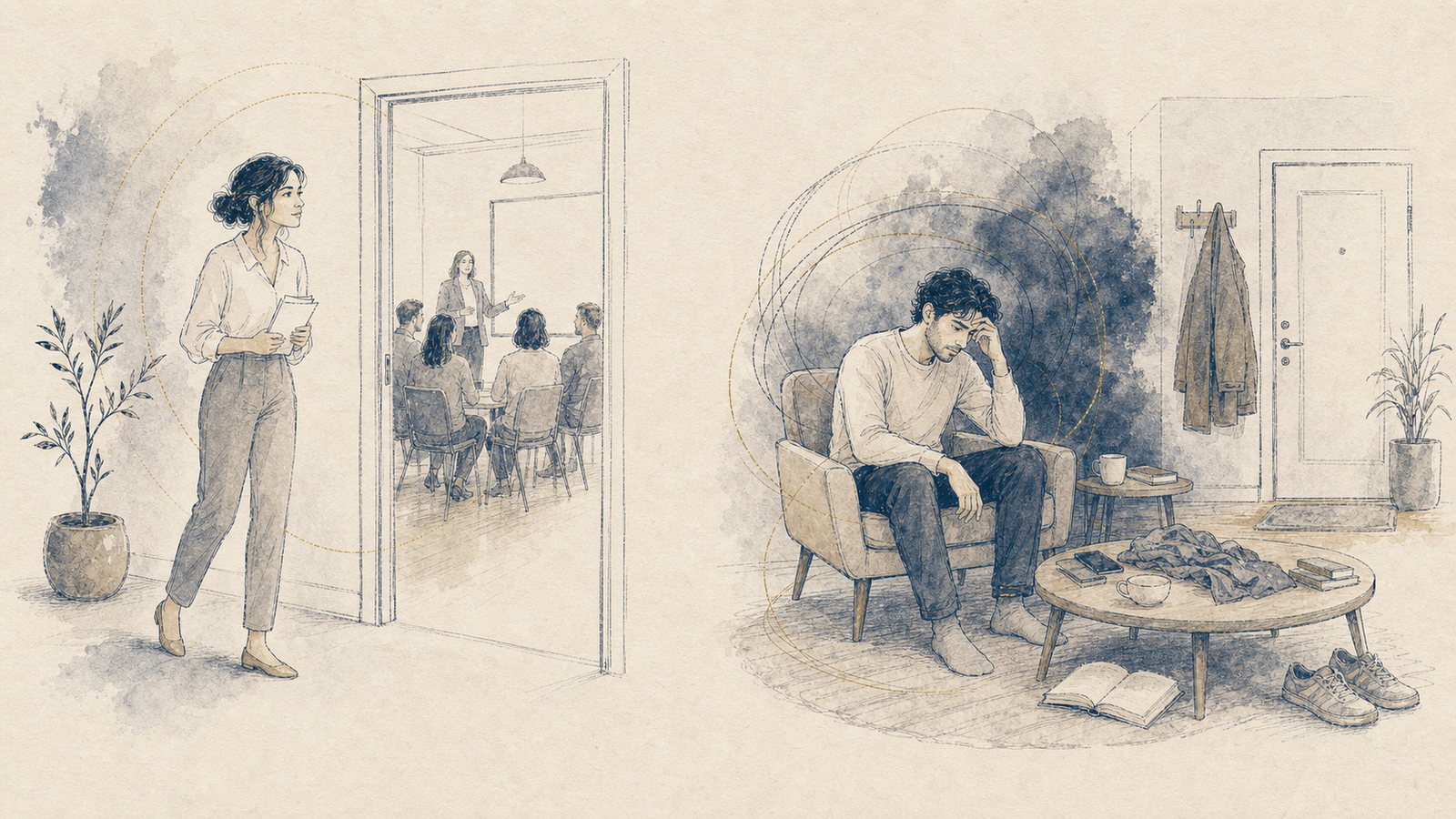
How one thought can take over an evening
Why Is It Important to Postpone Worry?
The point of worry postponement is not to stop you from having concerns or to persuade you that nothing matters. It is to stop one uncertain thought from taking over the next hour of your life.
Most people worry because it feels like doing something. It can feel as though you are preparing, protecting yourself, or being responsible. But when there is no clear action to take, worry often turns into repeated mental problem solving. You go over the same possibilities, look for certainty, and monitor how you feel. Your attention stays with the threat instead of returning to your work, your rest, or the person in front of you.
Thomas Borkovec and colleagues helped establish much of the research on worry. They described it as a repetitive, future focused attempt to solve uncertain problems in the mind. Their work links persistent worry with anxiety, tension, negative mood, intrusive thoughts, and difficulty keeping attention focused. This does not mean that every worry is harmful or that worry alone causes anxiety or depression. It means that when the process carries on for hours, it can keep negative feelings and threat monitoring going rather than resolve the problem.
A later three year study of 1,972 adults found that repetitive negative thinking, including worry, was associated with greater severity and persistence of anxiety and depression symptoms. This does not prove that worry causes every mental health problem. But it helps explain why it can matter to spend less time in the worry process.
Worry postponement gives you a way to test whether you really need to begin worrying every time a thought appears. It gives your attention an opportunity to return to your life before the thought has become an entire evening of mental work.
Why Does Worry Postponement Help?
Worry often feels like preparation. It can feel responsible. It can feel as though you are keeping yourself or the people you love safe.
But an hour of worrying usually does not give you an hour of useful preparation. More often, it gives you more scenarios, more doubt, and less attention for the life in front of you.
How much of your time goes into worrying and ruminating, and what could you do with that time instead? Use the free Worry & Rumination Calculator to see the hours add up and explore what the same time could make possible in your life.
Worry postponement is not only a technique. It is an experiment.
Each time you choose to delay the worry process, you test an important belief: I cannot control my worry. If you can leave the worry alone until later, even while the thought is still present, you have already discovered that the process is not as uncontrollable as it first felt.
A thought appears
I might make a mistake at work. What if my partner is distant? What if this feeling means something is wrong?
The old response
I analyse it, predict what will happen, check how I feel, search for certainty, or ask someone to reassure me.
The new experiment
There is a worry here. I will leave the worrying until my planned time and bring my attention back to what is in front of me.
How to Do Worry Postponement
1. Choose a short time later in the day
Choose a contained time of fifteen minutes, at roughly the same time each day. Do not choose immediately before bed.
This is not a promise that you must worry for the whole time. It is simply a place to return to the worry if you still want to.
2. Notice the trigger thought
When a thought appears that you would normally want to worry about, name what is happening as simply as possible.
There is a worry about my health.
There is a worry about work.
There is a worry about this relationship.
You do not need to decide whether the thought is true or false. You do not need to reassure yourself.
3. Postpone the worrying, not the thought
Try saying:
I can return to this later if I choose to. I am not going to work on it now.
The thought may still be in the background. That is okay.
The aim is not to get rid of the thought. The aim is to stop feeding it with more analysis, preparation, checking, or reassurance seeking.
4. Bring your attention back to what is already here
Return attention to the task, the meal, the meeting, the walk, the television programme, or the person in front of you.
This may feel strange at first. You may still feel uneasy. But unease is not an instruction. It is not proof that something needs to be solved immediately.
If the worry returns five minutes later, postpone it again. This is not failure. It is another opportunity to practise the same response.
5. See what is there when the time arrives
When your planned time comes, check what is actually there.
Often, the worry is less urgent. Sometimes it has gone. Sometimes there is a practical issue that needs a clear next step. If there is, take the practical step.
That is different from spending the entire evening trying to understand every possible meaning of one thought.
Why Does Worry Postponement Sometimes Not Work?
The most common problem is using the exercise as a way to make thoughts disappear.
You may say, “I will think about this later,” but secretly be checking every minute to see whether the thought has gone. You may be hoping that postponement will make you feel calm immediately.
Then postponement turns into another attempt to control your inner experience.
It is a little like telling someone not to enter a room, while standing at the door all day checking whether they are trying to get in. Your attention remains fixed on the very thing you are trying to leave alone.
Worry postponement works differently. You let the thought be present if it is present. You leave the worrying process alone. Then you return to your day.
Worry Postponement Is Not Thought Suppression
Thought suppression means trying to push a thought away.
Worry postponement means allowing the thought to be there without opening up a long conversation with it.
| Thought suppression | Worry postponement |
|---|---|
| “I must not think about this.” | “This thought can be here. I am not going to work on it now.” |
| The goal is to get rid of the thought or feeling | The goal is to reduce time spent in the worry process |
| Attention stays fixed on whether the thought has gone | Attention returns to what you were doing |
| You struggle with the thought | You leave the thought alone |
This is closely related to detached mindfulness: learning that a thought can pass through your mind without requiring a response.
Why Worry Feels So Urgent
In this video I explain why uncertainty can feel so urgent and what to do when your mind treats every doubt as something that needs an answer.
What Does the Research Say?
I have always made a point of keeping up with the research behind the tools I teach. I do not want you to leave with a list of techniques that sound sensible but have not been properly examined.
When I explain a tool, I look at what researchers actually asked people to do, what changed, and what that finding may mean in ordinary life. That way you can understand why the exercise matters, not just copy a set of instructions.
My research breakdown
Researchers tested different ways of postponing worry in an online study over fourteen days.
One group used a specific if then plan that named the situation, the postponement time, and where attention would go instead.
That specific plan reduced daily worry duration by about fifteen minutes compared with a standard postponement instruction.
The quality of the plan matters. Be precise about what you will do when a worry appears, when you will return to it, and what you will do with your attention now.
I have used that practical lesson to build the planner below. It is there to help you test the exercise properly, rather than simply telling yourself to stop worrying and hoping it will work.
Try It With a Worry That Is Here Now
A small MCT experiment
Choose how you want to use this tool
Use the first option when a thought is already pulling you into worry. Use the second when you want to rehearse the skill before the next time it happens.
Right now: choose a short period, start the timer, and return your attention to what is already in front of you. You are not waiting to feel calm first.
Choose a specific time. For example, 6:15 pm.
Your personal plan and countdown will appear here. Nothing you write is sent or saved.
This is an educational tool, not treatment or individual medical or psychological advice. It is designed to help you test one important belief: I cannot control my worry. It cannot assess your situation or replace appropriate professional support when anxiety is seriously affecting your daily life.
Frequently Asked Questions
Does worry postponement really work?
It can help you discover that worry is more controllable than it feels. It works best as an experiment in reducing the worrying process, not as an attempt to make thoughts or anxiety disappear.
What if I forget the worry by the time my worry period arrives?
You do not need to recover it. If a genuinely important practical problem remains, it can return later. Forgetting a worry often shows that it did not need hours of attention in the first place.
What if the thought keeps coming back?
Postpone the worrying again. A thought returning does not make it more urgent or more true. It only means that your mind has produced it again.
Is worry postponement the same as problem solving?
No. Problem solving is a short, concrete response to a clear and observable problem. Worry is repeated analysis aimed at getting certainty about what might happen. If there is a practical action to take, take it. If there is not, you do not need to keep thinking. I explain the difference and the practical steps in Reduce Worrying Through Strategic Problem Solving.
How long should a worry period be?
Start with fifteen minutes. The exact length is less important than the experiment: can you choose not to start worrying outside that period?
Where to Go Next
If worry is taking over your day, read How to Stop Worrying: 7 Ways to Break the Worry Cycle.
To understand the other MCT techniques that work alongside postponement, read Metacognitive Therapy Tools, Does Metacognitive Therapy Work and How?, and What Detached Mindfulness Is and How to Use It.
If you want a clear MCT explanation of why worry can feel necessary in the first place, read Metacognitive Therapy for Anxiety.
If persistent worry, rumination, checking, or reassurance seeking is affecting your work, sleep, or relationships, you can explore therapy.
References
Krzikalla, C., Buhlmann, U., Schug, J., Kopei, I., Gerlach, A. L., Doebler, P., Morina, N., and Andor, T. (2024). Worry Postponement From the Metacognitive Perspective: A Randomized Waitlist Controlled Trial. Clinical Psychology in Europe, 6(2), e12741. https://doi.org/10.32872/cpe.12741
McCarrick, D., Prestwich, A., Ferguson, E., and O’Connor, D. B. (2025). Effects of worry postponement on daily worry and sleep: a randomised controlled trial. Psychology and Health. https://doi.org/10.1080/08870446.2025.2590072
Borkovec, T. D., Ray, W. J., and Stöber, J. (1998). Worry: A cognitive phenomenon intimately linked to affective, physiological, and interpersonal behavioral processes. Cognitive Therapy and Research, 22, 561 to 576. https://doi.org/10.1023/A:1018790003416
Spinhoven, P., van Hemert, A. M., and Penninx, B. W. J. H. (2018). Repetitive negative thinking as a predictor of depression and anxiety: A longitudinal cohort study. Journal of Affective Disorders, 241, 216 to 225. https://doi.org/10.1016/j.jad.2018.08.037
Wells, A. (2009). Metacognitive Therapy for Anxiety and Depression. Guilford Press.