
Written and clinically reviewed by Shang Jul Rasul Olsen, Clinical Psychologist and specialist in Metacognitive Therapy, rumination and worry. Shang is co-author of the Danish book Fra overtænkning til nærvær: En guide til gode relationer, published by Gads Forlag. The book views relationship problems from an MCT perspective. An English edition is planned.

(Clinically reviewed 2026)
You are with someone you care about. They have been kind. They show up. Nothing obvious is wrong.
Then they seem quieter than usual. Or they do not answer a message in the way you expected. Or you notice that you do not feel as certain or excited as you think you should.
A though pops up in your mind:
Maybe they are pulling away.
Maybe I do not really love them.
Maybe I am going to get hurt.
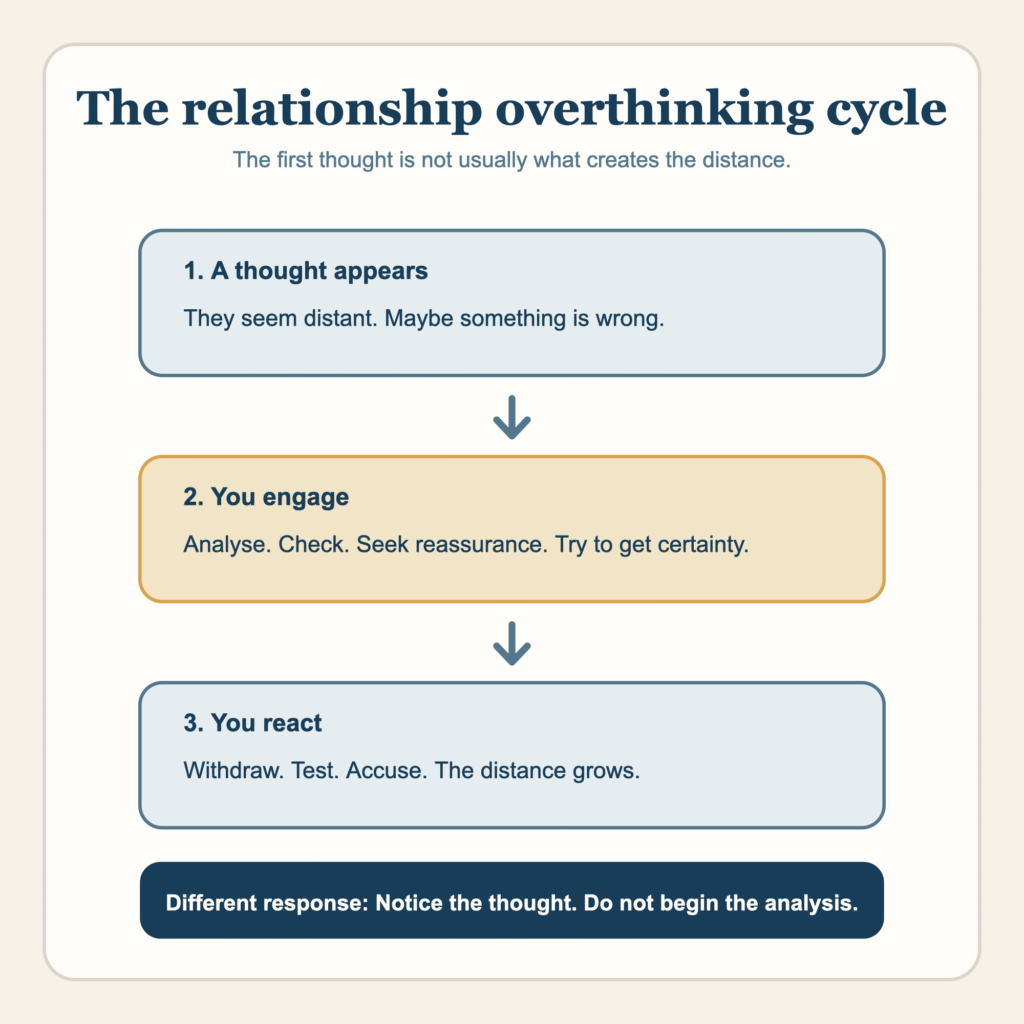
The thought feels important, so you start doing what you usually do with thoughts: You analyse it. You go back through old conversations. You check their tone. You ask whether everything is okay. You try to get rid of the feeling.
Some clients tell me that they know their partner is patient and loving, but they still find themselves starting an argument, asking the same question again, withdrawing, or deciding that the relationship must be wrong. Afterwards, they feel guilty and confused and beat themselves up about it. They ask, “Why do I do this when I actually want the relationship to work?”
You may call it self-sabotage. But you are probably not trying to destroy a good relationship. There is a good reason behind this: You are trying to feel safe, certain, and prepared. The issue is that the things you do to feel safe can create the distance you are most afraid of. Your partner might end up withdrawing. Your date will burn out from constantly being put through tests, your friends and family will be fed up from the drama.
In my book, Fra overtænkning til nærvær: En guide til gode relationer, written with Janus Olsen, we describe how overthinking often makes relationship problems larger than they need to be. A difficult conversation can turn into a week of analysis. A moment of uncertainty can become a test of whether the relationship is right. A small disappointment can become evidence that you are not loved.
A doubt is not the same as a relationship problem
Everyone has thoughts and feelings in relationships that they do not like.
You may feel jealous. You may feel uncertain. You may wonder whether you are appreciated. You may have a day where closeness feels difficult. You may notice a thought that says, What if this is not right? or What if they don’t care about enough?
The thought itself is not unusual. It is, in fact, very normal to have many negative, weird, and even bizarre thoughts. The problem, however, begins when you treat that thought as an instruction to start thinking.
There is an important difference between having a thought and spending the evening trying to solve it. You cannot choose every thought that appears in your mind. But you can become more aware of what you do next.
This matters because relationship overthinking often feels like responsibility. It can feel as though you are trying to protect yourself, avoid making a mistake, or make sure you do not waste your life with the wrong person.
But an hour later, you often have no more certainty than you had before. You have simply spent an hour worrying about the relationship.
How overthinking hurts a good relationship
Imagine that your partner is tired after work and says very little.
The first thought may be, They are annoyed with me.
That thought may be accurate. It may be inaccurate. It may simply be a thought your mind produced randomly. You do not know yet.
If you begin to analyse it, your attention becomes fixed on signs of danger. You monitor their movements, tone of voice, and expressions. You start to remember other evenings when they were tired. You notice every pause. You wonder whether they are losing interest. You start to feel anxious and rejected.
Then you may ask, “What is wrong?” several times. You may become cold. You may accuse them of not caring. You may stop talking. Or you may start testing whether they will come after you.
The original moment when the thought appeared may have been small. The overthinking, however, has made it much bigger. You are feeling hurt, anxious, angry, rejected, and exhausted. And if you decided to test your partner or start a fight, now you have another problem on top of it.
This is how people can end up hurting a relationship they value. Not because they are broken or because they secretly want to be alone. It is because the mind has convinced them that they need to keep checking until they feel certain.
Are you going through a breakup? Your mind is more resilient than you think. I made this video about how to overcome breakups with MCT.
Imagine that your manager gives you feedback on a piece of work and says, “I think this needs a little more work before we send it.”
You first thought may be, they do not think I am good enough.
That thought may be accurate. It may be inaccurate. It may simply be a thought your mind produced in response to feeling criticised. You do not know yet.
If you begin to analyse it, your attention becomes fixed on signs that you are not respected or valued at work. You replay the conversation in your mind. You remember other times your manager asked you to change something. You notice how brief their email was later that day. You compare how your manager speaks with your colleague. You start to wonder whether they regret hiring you or whether you are being pushed aside.
The more you analyze, the more you begin to feel anxious, embarrassed, angry, or rejected.
You then decide to use a set of strategies that don’t just end up confusing you, but also create a weird dynamic. You become quiet in meetings. You stop sharing your ideas. You may ask colleagues whether they think your manager has a problem with you. You may send a defensive email, avoid asking for clarification, or become cold towards the person who gave you the feedback.
The original moment when the thought appeared may have been small. The overthinking, however, has made it much bigger. You are now feeling hurt, worried, angry, and less confident. Your manager might respond defensively too, and before you know it, things have escalated and become uncomfortable.
The feedback may have been a simple request to improve a piece of work. But after hours or days of overthinking, it can feel like proof that you are failing.
What relationship self-sabotage often looks like
Relationship sabotage is not something that just happens, over which you don’t have control. Nor is it a personality trait, although it feels like a persistent default response. Relationship sabotage is made up of a handful of go-to strategies we may use when things become scary and uncomfortable. The good news is that they are learned strategies, and they CAN be unlearned.
You scan for signs that something is wrong
You watch how quickly they reply. You listen closely to their tone. You wonder why they used one word instead of another. You look for evidence that they are less interested, less loving, or about to leave. You pay close attention to how you feel
Noticing another person is not the problem. The problem is the constant monitoring and interpretation that follows. Once your attention scans a threat, you will find more things for your mind to work on.
You try to think your way into certainty
You ask yourself whether you love them enough. Whether they love you enough. Whether you are compatible enough. Whether you will regret staying or regret leaving.
Some of these questions do not have an answer that can be found by thinking harder at midnight. The more you try to feel certain, the more uncertain you become. It’s really ironic.
This is called rumination in MCT. You are turning the same question over and over, hoping it will finally feel settled. Read more about what rumination is and how to stop it according to MCT.
You ask for reassurance, then need it again
It is normal to ask a partner for comfort sometimes. But if you ask the same question repeatedly, reassurance can become part of the problem.
They say, “Of course we are okay.” You feel better for a moment. Then the doubt returns. You need another answer.
The relief is very reinforcing, but it is brief. It teaches your mind that doubt is dangerous and that you need another person to remove it for you.
You withdraw or start a fight before you can be hurt
Some people become quiet. Some become critical. Some say things they do not really mean. Some decide to leave while they are caught in a spiral of worry.
It may feel safer to create distance yourself than to wait and see whether someone else will disappoint you. But the result is often that both people feel less safe and less close.
You hold on to an old idea about yourself
There is another, subtle way we can push people away or make relationships painful. In my book, Fra overtænkning til nærvær, Janus Olsen and I write about how people can hold very tightly onto old ideas about themselves and their relationships.
It may be ideas like:
I am never chosen.
Nobody respects me.
I am invisible.
I am not attractive enough.
I will never be happy.
People always cheat on me.
Sometimes these ideas come from something that really happened. Perhaps you were rejected, criticized, overlooked, betrayed, or made to feel small. Sometimes they are conclusions you came to long ago and have never properly questioned. Either way, the idea can begin to feel like a fact about who you are and what you can expect from other people.
Holding on to it can feel strangely safe. It makes the world predictable. If you already know that you will be rejected, you do not have to risk being surprised by it. If you already know that nobody respects you, you can prepare yourself for every small sign that seems to confirm it.
But there is a cost. When you hold on to an idea like this, you often stop testing it. You notice the evidence that fits and dismiss the evidence that does not. You may pull away from someone who genuinely cares about you, assume criticism where there is none, or keep asking for proof that you are loved. Then the old idea remains protected, even when life is giving you reasons to question it.
This is one of the things I work with in therapy when someone feels stuck in the same relationship problems again and again. We look at the ideas they have come to believe about themselves, other people, and relationships. Then we find a way to examine whether those ideas are really as true and fixed as they feel. For many people, that work can have a profound impact on how they experience close relationships.
What to do instead
1. Notice that you have started overthinking
Ask yourself, “What am I doing in my mind right now?”
Are you replaying a conversation? Looking for hidden meaning? Imagining what might happen? Checking how you feel? Trying to work out whether the relationship is right?
2. Do not follow every thought with analysis
Instead of opening up the question and trying to solve it, try saying:
I am worrying here. I do not need to work on it right now.
This is not denial. It is choosing not to turn every thought or feeling into a deep wisdom that you have to get to the bottom of.
You can have the thought, Maybe they are upset with me, without immediately beginning the investigation. That is what detached mindfulness (a powerful MCT strategy) means in practice: you notice the thought, but you do not give it more of your attention.
3. Bring your attention back to what is actually happening
When you are overthinking a relationship, you are often not fully in the relationship. You may be sitting next to your partner while watching your own feelings, checking their behaviour, or preparing for what could go wrong.
Bring your attention back to the meal, the walk, the conversation, the work you need to finish, or the friends you are with.
You are not pretending the doubt did not happen. You are simply not allowing it to take over your whole evening. This will also open up the opportunity to discover something new about your relationship: maybe your partner is just tired, maybe they are worrying about something, maybe they think you need peace, and they are therefore leaving you alone. Or maybe they are about to declare their deep love for you.
4. Postpone the urge to check or ask again
If you feel an urgent need to ask, “Do you still love me?” or “Are we okay?”, postpone the question first.
Choose a short time later in the day. Until then, leave the worry alone and continue with what you were doing.
This does not mean you can never have an important conversation. It means you are giving yourself a chance to discover whether the urge is a real need for a conversation or the old habit of trying to get certainty immediately.
You can use the same approach described in my guide to worry postponement.
5. Separate a real issue from the worry process
There are relationship problems that need to be addressed. Repeated dishonesty, broken agreements, cruelty, controlling behaviour, and a boundary that is ignored are not thoughts you should simply leave alone.
But ask a practical question: Is there a clear and observable issue that needs a conversation or a decision?
If there is, keep the next step concrete.
“When our plans change at the last minute several times, I feel disappointed. Can we talk about how to handle that differently?”
“I do not want to be spoken to like that. I need us to pause and return to this when we can talk calmly.”
That is different from spending the whole night trying to understand what one message meant.
You do not need complete certainty to be close to someone
Many people live by a quiet rule: I cannot relax until I know for certain that this relationship is safe and right.
But relationships involve uncertainty. You can never control every feeling, every future outcome, or every thought that your partner has.
You can feel uncertain and still be warm. You can have a jealous thought and choose not to interrogate someone. You can feel anxious and still wait before you send the message that might start an argument.
Thoughts can show up. Doubt can show up. Anxiety can show up. You can still choose where your attention goes.
This article explains why thoughts are not as important as they often feel.
When to get support
This article is about the overthinking that can make ordinary relationship uncertainty more painful. It is not a reason to stay in a relationship that is abusive, coercive, persistently controlling, or unsafe. If you are afraid of your partner or being harmed, seek support from a trusted professional or a local domestic abuse service.
If worry, rumination, checking, or reassurance seeking is taking over your relationship, therapy can help you practise a different response. You can find information about therapy here.
About the book
Fra overtænkning til nærvær: En guide til gode relationer is a Danish book by Shang Jul Rasul Olsen and Janus Jul Rasul Olsen, published by Gads Forlag. It examines how overthinking can affect romantic relationships, friendships, family, dating, and work relationships. An English edition is planned.
Sources and review notes
- Rasul Olsen, S., and Olsen, J. (2025). Fra overtænkning til nærvær: En guide til gode relationer. Gads Forlag.
- Wells, A. (2009). Metacognitive Therapy for Anxiety and Depression. Guilford Press.
- O’Brien, E. J., Morrison, A. P., and Taylor, P. J. (2024). Do patient interpersonal problems improve following metacognitive therapy? A systematic review and meta analysis. Clinical Psychology and Psychotherapy, 31(2), e2973.