

Written and clinically reviewed by Shang Jul Rasul Olsen, Clinical Psychologist and specialist in Metacognitive Therapy, rumination and worry.
(Last clinically reviewed: July 2026)
You are trying to concentrate on work, enjoy dinner, sleep, or be present with someone you love. Then a thought arrives:
What if I make the wrong decision?
What if something bad happens?
What if I cannot cope when it does?
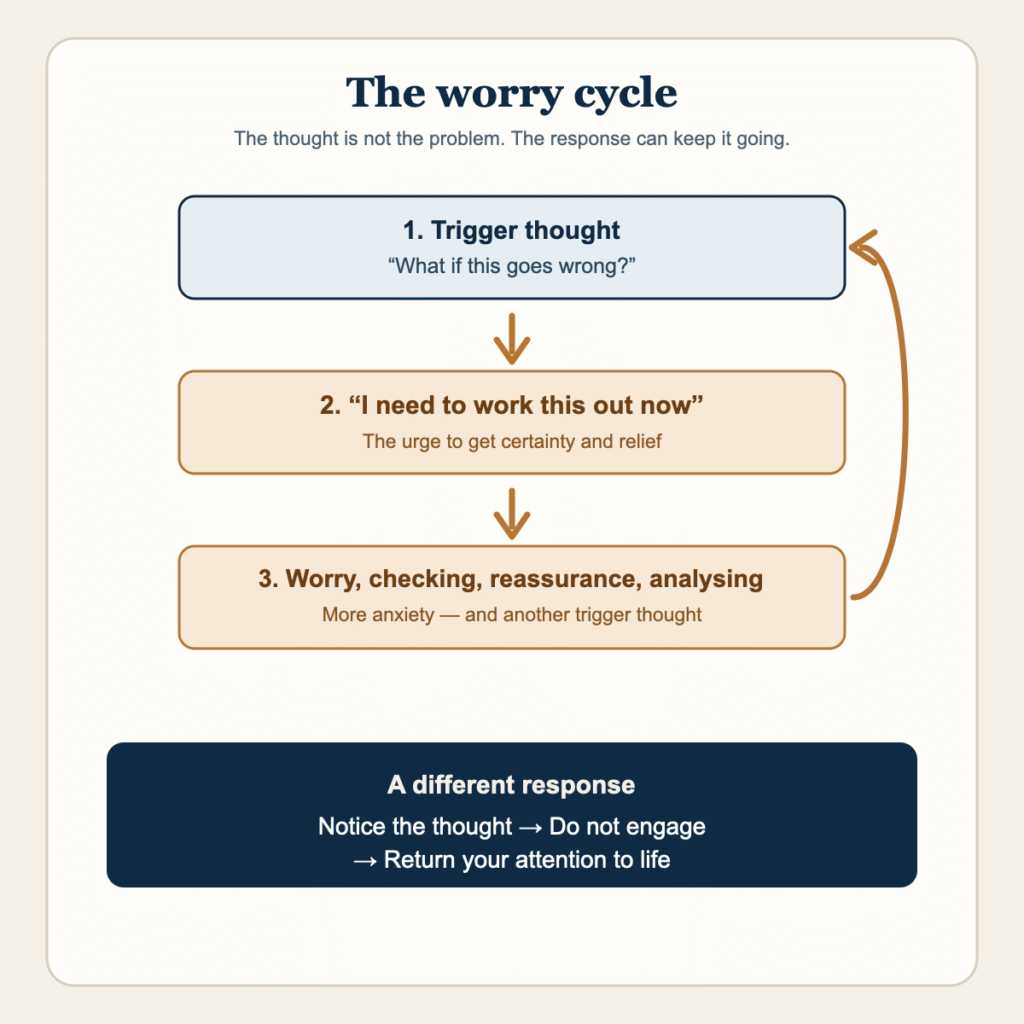
It feels important, so you start doing what your mind has taught you to do: analyse it, prepare for every outcome, look for reassurance, or try to get rid of the thought.
The problem is that an hour later you often have no more certainty than you had before. You have simply spent an hour worrying.
How much of your time goes into worrying and ruminating, and what could you do with that time instead? Use the free Worry & Rumination Calculator to see the hours add up and explore what the same time could make possible in your life.
Worry can feel like you are taking responsibility. It can feel like preparation. It can feel as though you are trying to keep yourself or the people you care about safe. But worry is usually not what protects you. It is repetitive thinking that keeps you away from the life happening in front of you.
Here are seven ways to stop giving worry so much of your attention.
1. Notice the thought that starts the worry, then do not follow it
Worry often begins with a trigger thought (a trigger thought is simply just a thought that pops up and triggers us to start engaging with it. Often through either worry or rumination):
What if I lose my job?
What if this feeling means something is wrong?
What if they are upset with me?
What if I made a terrible mistake
The thought itself is not unusual. Everyone has thoughts like this. The difficulty begins when you treat it as an instruction to start thinking.
You cannot choose every thought that appears in your mind. But you can become more aware of what you do next.
Instead of opening up the question and trying to solve it, try saying:
“There is a worry here. I do not need to work on it right now.”
Then bring your attention back to the email, the meal, the meeting, the walk, or the conversation that was already in front of you.
This is not denial. It is choosing not to turn every mental event into a project you need to work on.
2. Use worry postponement as an experiment
Almost all my clients initially believe that worrying is something they can’t stop doing. So we do experiments in our sessions to disprove that. If you believe that your worry is uncontrollable, worry postponement is a useful experiment.
Choose a short, contained time later in the day, for example, 15 minutes. When a “worry” comes up before then, do not argue with the thought or try to push it away. Simply postpone the worrying process.
“I can return to this later if I choose to. I am not going to work on it now.”
At the planned time, see what is actually there. Often, the worry is less urgent than it first seemed. Sometimes it has disappeared. Sometimes it is still there, but it no longer feels like an emergency.
The point is not to prove that you can stop thoughts entering your mind. The point is to discover that you can have more influence over how much time and attention you give them. That you in fact have full control over how much you choose to worry.
Read the complete worry postponement guide here
3. When the “worry” comes back, leave it alone again
The same thought may return five or ten times. That does not mean you have failed.
The old habit is to think, “It is back so it must be important.” But a thought returning does not make it more urgent or more true. It just means your mind has produced it again.
Each time, notice the pull to analyse, check, Google, rehearse, or ask for reassurance. Then choose not to feed it.
Remember, we are not going for a perfect response. This is a practical skill: repeatedly declining to begin the worry cycle. Because this is something you CAN choose.
4. Do not treat anxiety and unease as messages you have to decode
Many people do not only worry about events. They worry about the worry itself:
Why do I feel so unsettled?
What is this anxiety trying to tell me?
What if this feeling gets worse?
Anxious feelings can be unpleasant. But unpleasant does not automatically mean dangerous, meaningful, or in need of analysis.
When you repeatedly monitor your anxiety and try to work out why it is there, you give it more attention. It can become the centre of your day. That is obviously not what you want. You want to let take care of itself, which it will eventually, if you don’t do anything about it.
Try allowing the feeling to be present while you continue with what matters. You do not need to force yourself to feel calm. And you do not need to understand the feeling before you can carry on. Not all feelings carry inherent meaning.
5. Separate practical preparation from worry
There is a real difference between preparing for something and worrying about it.
Preparation (or problem-solving) is specific. You make notes for the presentation. You send the email. You book the appointment. You check the deadline. Then you are finished.
Worry is open-ended. It asks questions that cannot be settled right now:
What if I get it wrong?
What if I regret it?
What if I cannot handle it?
If there is a useful action to take right now, take it. If there is no action available, more thinking is unlikely to create the certainty you want. I talk more about this idea here.
This distinction matters especially for people who worry because they want to be responsible. You can be prepared without spending all day frightening yourself in advance.
6. Ask what worry is doing for you and what it is costing you
Most people keep worrying because, somewhere, it feels useful. My clients tell me that prior to receiving MCT, they believed that worrying made them more prepared, caring, motivated, or less likely to be caught off guard if something bad happened.
And you too can begin to challenge that idea. So rather than telling yourself that worry is irrational, ask a more honest question:
“What does worrying actually do for me?”
Does it make you clearer and more effective? Or does it make you more tired, distracted, uncertain, and less present with the people and work you care about?
My clients often notice the difference between the promise worry makes and the effect it has on their lives. That is often the thing with worrying: if feels like you are being productive and prepared, but really, you are just heading toward more anxiety.
7. Stop treating worry as dangerous or impossible to control
Worry can feel powerful, especially when it has become a long-standing habit (habit as in you worry every time you feel nervous or uncertain, not as in your brain has profoundly changed). But feeling unable to stop does not mean you have no choice at all.
You may not control the first thought. You may not control whether anxiety appears. But you can practise controlling the next move: whether to begin the chain of analysis, checking, reassurance-seeking, or mental preparation.
In my video, Why Do We Struggle With Uncertainty And What To Do About It (see below) I explain the central issue: uncertainty is part of life. The problem is the rule that you must keep thinking until uncertainty feels safe.
That rule cannot be satisfied. There will always be another possibility to consider.
Learning to leave a worry alone is not about becoming careless. It is about finding out that you can live with uncertainty without handing it your whole day.
When to get support
Self-help techniques can be useful (I talk about MCT self-help here), but persistent worry deserves support when it is affecting sleep, work, relationships or daily functioning; when it is tied to compulsive checking or reassurance-seeking; or when you feel trapped in repetitive thinking despite trying to change it.
The goal is not a life without worrying thoughts. The goal is a life in which a worrying thought does not automatically become a problem you have to solve.
Thoughts can show up. Uncertainty can show up. Anxiety can show up. BUT you can still choose where your attention goes.
If you want help learning how to do this procedurally, you can sign up for therapy here.
Sources and review notes
1. Krzikalla C, et al. *Worry Postponement From the Metacognitive Perspective: A Randomized Waitlist-Controlled Trial.* Clinical Psychology in Europe. 2024. [PubMed](https://pubmed.ncbi.nlm.nih.gov/39119056/)
2. Wells A. *Metacognitive Therapy for Anxiety and Depression.* Guilford Press; 2009.
3. Normann N, van Emmerik AAP, Morina N. The efficacy of metacognitive therapy: A systematic review and meta-analysis. *Frontiers in Psychology.* 2018;9:2211. [Full text](https://pmc.ncbi.nlm.nih.gov/articles/PMC6246690/)